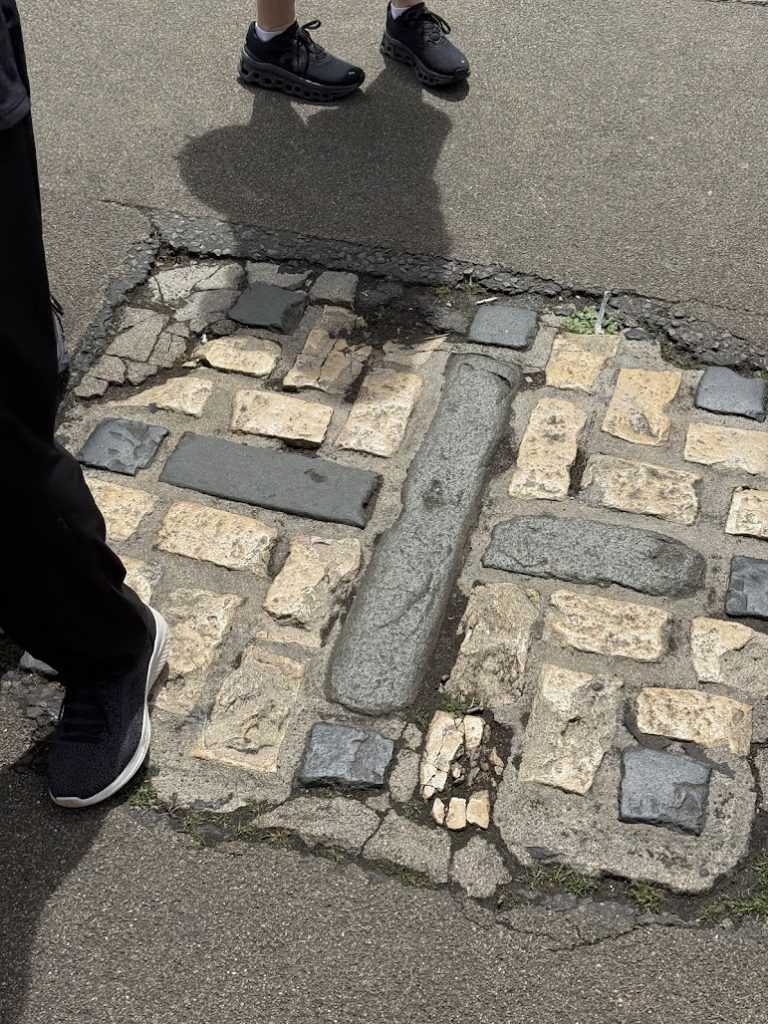
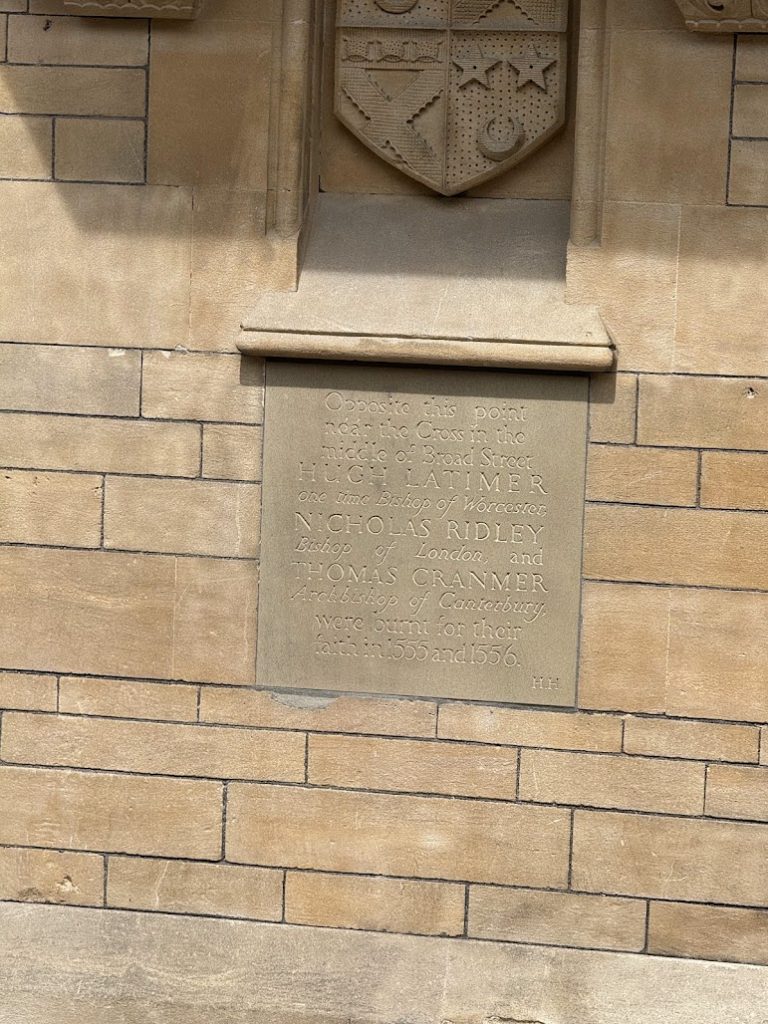
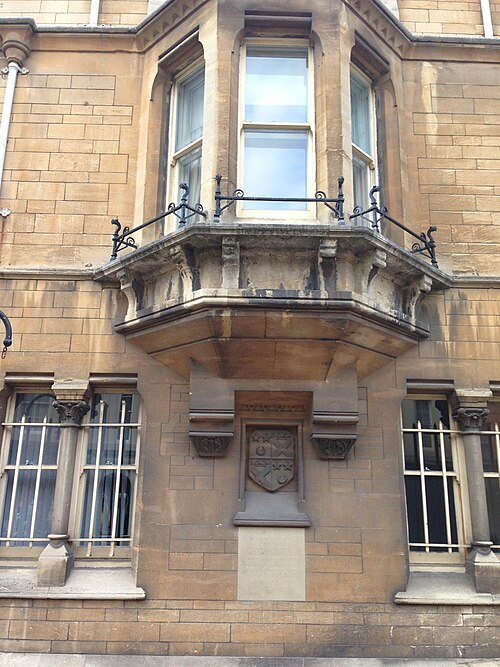
The Martyrs’ Memorial—often referred to as the “Martyrs’ Cross”—is one of the most meaningful historical markers associated with the English Reformation. Located in Oxford, it commemorates the place where three prominent Protestant leaders—Hugh Latimer, Nicholas Ridley, and Thomas Cranmer—were executed during the reign of Queen Mary I in the mid-sixteenth century.
The “Martyrs’ Cross” itself is not a large standing monument but rather a simple cross set into the pavement at the intersection of Broad Street and St. Giles’ in Oxford. It marks the approximate location where Latimer and Ridley were burned at the stake in 1555, followed by Cranmer in 1556. This understated marker contrasts with the nearby Victorian-era Martyrs’ Memorial, a more elaborate stone structure erected in the nineteenth century to honor the same figures.
The historical background of the Martyrs’ Cross lies in the turbulent years of religious conflict following the English Reformation. Under Mary I of England, efforts were made to restore Roman Catholicism in England and to reverse the reforms introduced under her predecessors. Those who had played leading roles in promoting Protestant doctrine were targeted for trial and punishment. Latimer, Ridley, and Cranmer, having been central figures in shaping the Reformed Church of England, were among the most prominent victims of this policy.
The executions carried out at this site were intended to serve as a warning to others. Burning at the stake was a public and severe form of punishment for heresy, meant to demonstrate the consequences of rejecting established doctrine. Yet, rather than silencing dissent, these events had the opposite effect. The courage and composure shown by the martyrs, particularly the famous words attributed to Latimer as the fire was lit, left a deep impression on witnesses and later generations.
Over time, the site of their execution became a place of remembrance. The Martyrs’ Cross, though simple, serves as a powerful symbol of the sacrifices made during this period of religious upheaval. Its placement in a busy street ensures that the memory of these events remains woven into the daily life of the city, rather than confined to a distant or secluded location.
The legacy of the Martyrs’ Cross is closely tied to the broader story of religious freedom and conscience. The deaths of Latimer, Ridley, and Cranmer were later recorded in works such as John Foxe’s Book of Martyrs, which helped to shape Protestant identity in England. Their willingness to stand by their convictions, even in the face of death, has been remembered as an example of steadfast faith and moral courage.
Today, visitors to Oxford often pause at the Martyrs’ Cross to reflect on the events it commemorates. While it lacks the grandeur of larger monuments, its simplicity gives it a particular weight and dignity. It invites quiet contemplation rather than spectacle, encouraging those who pass by to consider the cost of the freedoms they now enjoy.
In its modest form, the Martyrs’ Cross continues to bear witness to a defining chapter in English history. It stands as a reminder that deeply held beliefs have often come at a great price and that the legacy of those who endured such trials continues to shape the present.
♦ _____ ♦
“Be of good cheer, Master Ridley, and play the man, for we shall this day light such a candle in England as I trust by God’s grace shall never be put out!”
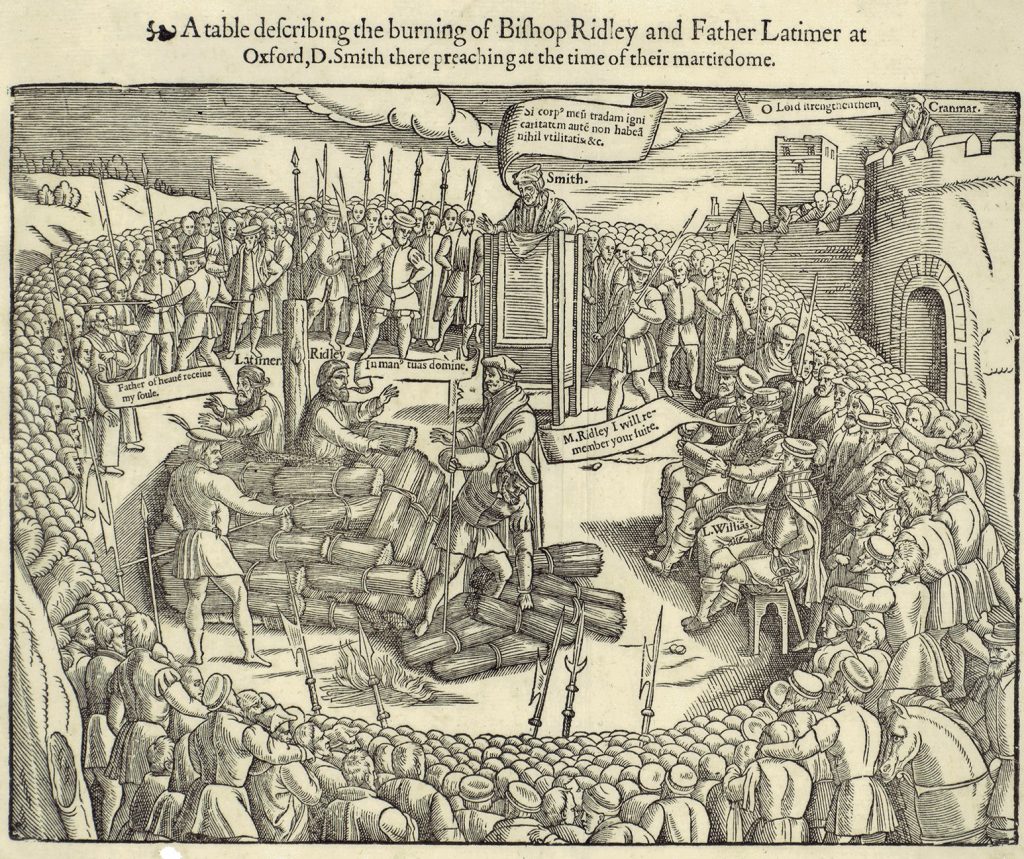
Martyrdom of Bishop Ridley and Latimer
The three were tried at University Church of St Mary the Virgin, the official church of the University of Oxford on the High Street, Oxford. The men were imprisoned at the former Bocardo Prison near the extant St Michael at the North Gate church (at the north gate of the city walls) in Cornmarket Street. The door of their cell is on display in the tower of the church.[1]
The men were burnt at the stake just outside the city walls to the north, where Broad Street is now located. Latimer and Ridley were burnt on 16 October 1555 for denying the Roman Catholic dogma of Transubstantiation. Cranmer was burnt five months later on 21 March 1556.[2]
A small area paved with granite setts forming a cross in the centre of the road outside the front of Balliol College marks the site.[2][3] The Victorian spire-like Martyrs’ Memorial, at the south end of St Giles’ nearby, commemorates the events.
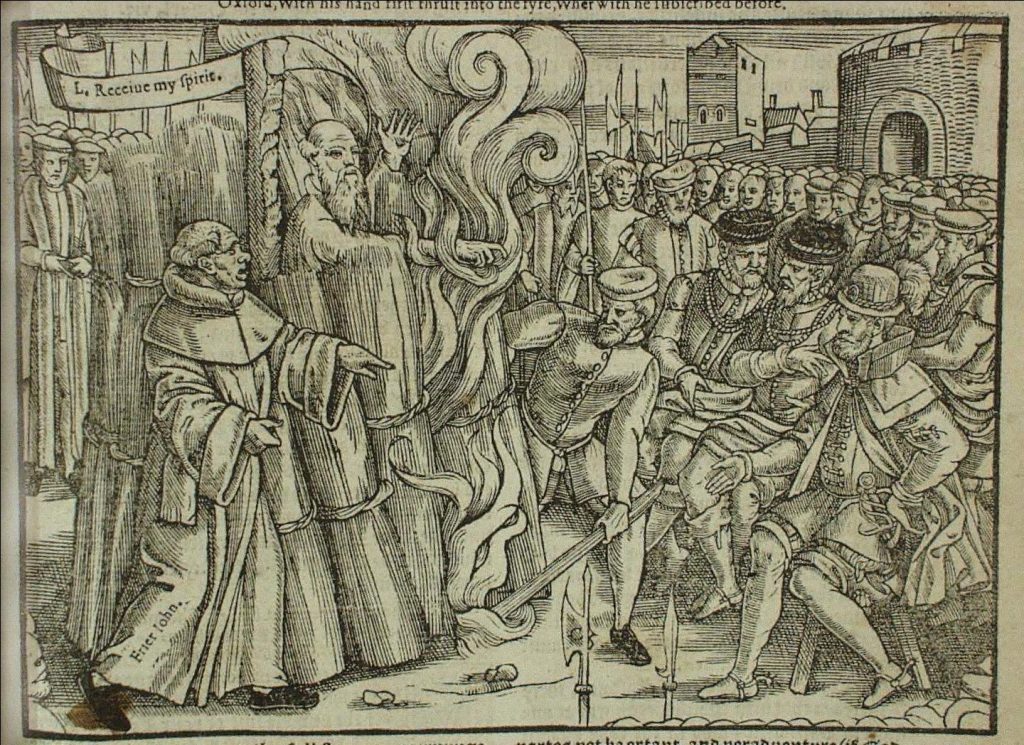
Martyrdom of Thomas Cranmer
As the flames drew around him, [Thomas Cranmer] fulfilled his promise by placing his right hand into the heart of the fire, calling it “that unworthy hand”. His dying words were, “Lord Jesus, receive my spirit. I see the heavens open and Jesus standing at the right hand of God.”[108]
_____
Image Source/Credit (in order):
• Photo by the author
• Set in Stone Project, CC BY-SA 4.0 <https://creativecommons.org/licenses/by-sa/4.0>, via Wikimedia Commons
• Tony Holding, CC BY-SA 3.0 <https://creativecommons.org/licenses/by-sa/3.0>, via Wikimedia Commons