Our Christian Heritage

  • Browse/Search Sites
  • Map
  • OI Tour
  • Podcast
  • OCH TV
  • VCY
  • About

Search Results for: beale

John Mason Peck (Shurtleff College)

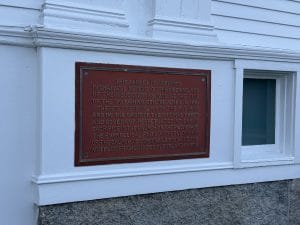
Pioneer missionary, John Mason Peck (1789-1858), saturated Missouri and Illinois with the gospel, evangelizing, organizing churches, and establishing the Baptist movement in the West. At Southern Illinois University Dental School, this memorial plaque highlights his life and legacy:


On this site in 1831, John Mason Peck (1789-1858), pioneer Baptist preacher, author, and educator, established the school which became Shurtleff College. In 1817, Peck had left his home in New England with a vision “to bring the lamp of learning and the light of the gospel” into the undeveloped West. He, his wife Sally, and three children endured an arduous four month trip in a small one-horse wagon, setting in Rock Spring, near O’Fallon, Illinois.

There, in 1827, Peck founded Rock Spring Seminary, the first institution of its kind in the State of Illinois. In 1831, the seminary was moved to the growing city of Alton, where, in 1836, the name was changed to Shurtleff College, recognizing the gift of $10,000 from Dr. Benjamin Shurtleff of Boston.

John Mason Peck is well described as a missionary and a teacher, an author and an editor, a geographer and a cartographer, and a promoter of churches, schools, and western settlement. For thirty years, he was undoubtedly one of the strongest advocates of education and righteousness in the entire Mississippi Valley. He traveled hundreds of miles by horseback or wagon, often under most difficult circumstances, while his wife and children bore his long absences with fortitude.

Peck was one of the foremost ministerial opponents of slavery in Illinois and provided great support to Governor Edward Coles’ successful anti-slavery effort in 1824. In 1851, he was honored with a Doctor of Divinity degree from Harvard University. He died on March 16, 1858, and is buried in Bellefontaine Cemetery in St. Louis.

copyrighted and used by permission from David Beale, Baptist History in England and America: Personalities, Positions, and Practices

♦ _____ ♦

From Wikipedia:

Peck became active in establishing Bible societies and Sunday School associations. Distributing Bibles “silently undermine[d] the opposition to missions” of geographically stable preachers such as Daniel Parker, as well as spread literacy and Christian principles (including temperance and opposition to slavery) among the dispersed rural population. Peck moved to Rock Springs, Illinois in 1822 to farm, and arranged a circuit to visit the various societies which he continued to establish, as well as isolated farms. On one trip, Peck visited Daniel Boone, then nearly 80, and later wrote a book about the frontiersman’s life.

In 1824 Peck’s preaching helped Illinois Governor Edward Coles defeat efforts to revise Illinois’ constitution to permit slavery. Four years later, black Baptists in St. Louis sought to establish their own church, and with Peck’s help they established the African Church of St. Louis (later renamed the First Baptist Church of St. Louis). Of the original 220 members, 200 were slaves. Peck ordained a young freeman, John Berry Meachum, as their pastor.[4] When that church’s members voted themselves out of existence, Peck helped establish the Second Baptist Church in 1833, serving as its interim minister three times in the 1840s.

Convinced that Baptists could not rise without educated preachers, Peck founded a seminary at his Rock Springs farm near O’Fallon, Illinois, but his first attempt to secure a charter failed because of opposition by an anti-mission preacher/legislature. Undeterred, Peck moved his new school to Upper Alton, Illinois. In 1836, after a significant contribution from Benjamin Shurtleff, M.D. of Boston, it became Shurtleff College, which became part of the Southern Illinois University system in 1957.[5] Peck then established the Illinois Baptist Education Society, serving as its first secretary.

The American Baptist Home Mission Society was organized in 1832, under Peck’s influence, with Jonathan Going (sent from Massachusetts at his request the previous year) as the first secretary. This society, like Peck, directed its efforts toward the people of the frontier: Settlers, Native Americans and later former Confederate slaves.

_____
Image Source/Credit:
• Genealogy Trails History Group. Biography of John Mason Peck From Madison County, Illinois (genealogytrails.com/ill/madison/John_Peck.html)
Kiokee Baptist Church

Old Kiokee Baptist Church, founded by Daniel Marshall, is the earliest continuing Baptist church in Georgia. They erected their third (present) meetinghouse, in 1808, with its quaint auditorium, gallery, and hand-hewn pews. The congregation uses this building, at 2520 Ray Owens Road, for special services. For access, contact the church (706-541-1086). Inquire about the Marshall home-site and cemetery.

Copyrighted and used by permission from David Beale, Baptist History in England and America: Personalities, Positions, and Practices

♦ _____ ♦


Kiokee Church, the first Baptist Church to be constituted in Georgia, was organized in the Spring of 1772, by the Rev. Daniel Marshall, one of the founders of the Baptist denomination in Georgia. A meeting house was built, and the Rev. Daniel Marshall became the first pastor, ministering from his headquarters at Kiokee to an ever increasing number of Baptists in the area. In October, 1784, the preliminary meeting for the organization of a Georgia Baptist Association was held at Kiokee Church. The Rev. Daniel Marshall died November 2, 1784, and some time later the church was moved to Appling and a new brick edifice erected. Kiokee Baptist Church was incorporated December 23, 1789, as “The Anabaptist Church on Kiokee”, with Abram Marshall, William Willingham, Edmund Cartledge, John Landers, James Simms, Joseph Ray and Lewis Gardner as Trustees.

♦ _____ ♦


Kiokee is Georgia’s oldest continuing Baptist church. Seventh Day Baptists began the first Baptist church in the state (1759) but the congregation existed only a short while.

It appears evident that Big Stevens Creek Church (South Carolina) established a mission point in Appling. The congregation became a Baptist church in the spring of 1772, probably taking the name “Kiokee” after the creek on which it was located. Legend asserts that “kiokee” was a term common to both the Cherokee and the Creek Indians for whom the Fall Line was a tribal border. It has been suggested that the creek system which is now known as Kiokee came to be so named in order to indicate that the water in the area was “sweet” or drinkable. The venerable Dr. Louie Newton suggested that an alternate interpretation of the term may have been “falls creek.”

Kiokee has the distinction of having had a father, son, and grandson as pastors during the first sixty years of its history. Daniel (1772-1784), Abraham (1784-1819), and Jabez (1819-1832) Marshall set a record which few other churches have known. Few, if any, Georgia pastors have had the extensive evangelistic and missionary ministry of Kiokee’s first two pastors. Daniel preached his way to Georgia after catching his “seraphic fire” under the influence of the Great Awakening. His arrest and trial when he began reaching in Georgia was not unlike an experience in the life of Paul the Apostle. Marshall, the “stammerer,” who was “no scholar” had a warm heart. Though a “Separate” with strong convictions, he reached out with love and affection to his brother of the “Regular” tradition, Edmond Botsford, founder of the Botsford congregation in Burke County in 1773. Abraham preached to thousands on New England tours in 1786 and 1792. The ministry of Jabez was cut short due to his death by measles on March 29, 1832. Collectively their commitment to cooperation was the beginning of a great denomination. It acquired the best characteristics of both groups. The denominational and organizational skills of the “Regulars” were combined with the evangelism and missions passions of the “Separates” to shape the Southern Baptist Convention as we know it today.

There is an equally impressive list of churches whose origins can be traced to Kiokee: Red’s Creek (Abilene), Little Brier Creek, Fishing Creek, Upton’s Creek (Greenwood), Grove, Phillips’ Mill, Bethesda, Clark’s Station, Sharon, Damascus, Marshall, Powelton, the First African Churches of Augusta and Savannah, and the First Baptist Church of Augusta.

The location of Kiokee’s first church building remains unknown. The congregation erected a structure around 1792 called “Marshall’s Meetinghouse.” In 1808, the Old Kiokee building was erected on this site where we meet today. An Appling chapel was built about 1828 and used as a mission of the church until it was destroyed by a tornado in 1875. Legend suggests that this same tornado provides an explanation for the turnbuckles seen in Old Kiokee. The turnbuckles are said to represent the effort of the trustees of that era to pull the top half of the building back around in line with the bottom. The fifth structure was an abandoned Methodist church building known as “St. Mary’s.” It was bought and moved to Appling in 1907 and used until 1937. The sixth meeting house currently serves as a chapel and was erected in 1937. The seventh and current meeting house was completed in 1995.

Taken from the Kiokee Baptist Church website (www.kiokee.org)

_____
Image Source/Credit (in order):
• AugustaGALiving, CC BY 2.0 <https://creativecommons.org/licenses/by/2.0>, via Wikimedia Commons
• First Baptist Church in Georgia Historical Marker. 23 Feb. 2021 (www.hmdb.org/m.asp?m=27064)
• Samuel. “Kiokee Baptist Church.” Georgia Southern Commons (digitalcommons.georgiasouthern.edu/samuelhoodpapers/2)
• Creelan, Marilee. “Columbia County.” New Georgia Encyclopedia, June 2022 (www.georgiaencyclopedia.org/articles/counties-cities-neighborhoods/columbia-county)

Old Baptist Cemetery

In the 700 block of Church Street, the remains of Edmund Botsford (1745-1819), early pastor of Antipedo Baptist (later First Baptist) Church, lie buried in the Old Baptist Cemtery. A marker was placed at Botsford’s grave in 2004.

Copyrighted and used by permission from David Beale, Baptist History in England and America: Personalities, Positions, and Practices


The Cyclopedia of Biblical, Theological, and Ecclesiastical Literature. James Strong and John McClintock; Haper and Brothers; NY; 1880.

In the plan of Georgetown, laid out by 1730, this one acre lot was reserved for Antipedo Baptist by Elisha Screven. A brick building built before the Revolution for the Baptists, Presbyterians, and independents housed the area Baptists who were constituted 1794. By 1804 its congregation had built “a handsome and commodious wooden meetinghouse” on this lot, commanding a view of the whole town from the front.

Old Baptist Cemetery

Among the graves here are those of William Cuttino, Sr., treasurer and builder of the Antipedo Baptist Church and John Waldo, minister and educator. Other early leaders buried here include the Rev. Edmund Botsford, native of England who became minister of this church in 1796; and Savage Smith, president of the church in 1805.

Botsford, Edmund a Baptist minister, was born at Woburn, Bedfordshire, England, in 1745. He was converted at Charleston, S. C., in 1766, and licensed to preach in February, 1771. His first congregation was about forty miles from Savannah, but he also preached in Georgia. He was ordained pastor at Charleston; March 14, 1773. Subsequently he served several churches in Virginia, and closed his earthly labors in Georgetown, S. C., Dec. 25, 1819. He published The Spiritual Allegory: — Sambo and Toney: — and A Dialogue between Two Servants. See Sprague, Annals of the Amer. Pulpit, 6 138.

Memoirs of Edmund Botsford (PDF)

_____
Image Source/Credit:
• Photo: Antipedo Baptist Church / Old Baptist Cemetery Marker (www.hmdb.org/PhotoFullSize.asp?PhotoID=420681)

Thomas Jefferson Religious Freedom Monument

On Washington Avenue, stands the Thomas Jefferson Religious Freedom Monument, made from stones sent from churches across the country. It commemorates Jefferson’s Virginia Religious Freedom Statute, promising that “no man shall… suffer on account of his religious opinions or belief.” The Statute became the basis for the religion clause of the First Amendment.


copyrighted and used by permission from David Beale, Baptist History in England and America: Personalities, Positions, and Practices


Thomas Jefferson was brilliant.

When President John F. Kennedy spoke at an event for Nobel Prize winners from the Western Hemisphere, he said “I think this is the most extraordinary collection of talent, of human knowledge, that has ever been gathered together at the White House, with the possible exception of when Thomas Jefferson dined alone.”

Of all of Jefferson’s achievements, he chose to mark only three on his tombstone, author of the Declaration of Independence, author of the Statue of Religious Freedom, and father of the University of Virginia.

It took almost ten years from the first meeting in 1777, until the General Assembly passed it in 1786, but eventually religious freedom was protected by the government.

In contrast to the secular view that religious tolerance followed religious apathy, note the wording Jefferson used:

Whereas Almighty God hath created the mind free; that all attempts to influence it by temporal punishment or burthens, or by civil incapacitations, tend only to beget habits of hypocrisy and meanness, and are a departure from the plan of the Holy author of our religion, who being Lord both of body and mind, yet chose not to propagate it by coercions on either, as it was in his Almighty power to do;

Jefferson’s Religious Freedom

Jefferson went on to declare, “if any act shall be hereafter passed to repeal the present, or to narrow its operation, such as would be an infringement of natural right.”

Note the argument of ‘natural law’ – as we observe the Almighty Creator, he had the power to command worship in this dispensation, but chose not to, therefore we should likewise refrain, and allow man to love God freely, and not of compulsion

Inscription:

From a meeting in Fredericksburg, January 3-17, 1777, of a Committee of Revisors appointed by the General Assembly of Virginia, composed of Thomas Jefferson, George Mason, Edmund Pendleton, George Wythe and Thomas Ludwell Lee to “settle the plan of operation and to distribute the work” evolved The Statute of Religious Freedom authored by Thomas Jefferson in the document the United States of America made probably its greatest contribution to government recognition of religious freedom.

This memorial marks the site of a celebration on October 16, 1932, by representatives of the leading religious faiths in America, commemorative of the religious character of George Washington, whose boyhood home was Fredericksburg; and of the separation of church and state, as the Virginia “Bill for Establishing Religious Freedom” was outlined by a committee consisting of Thomas Jefferson, George Mason, Edmund Pendleton, George Wythe and Thomas Ludwell Lee which met in this city on January 13, 1777.

_____
Image Source/Credit:
• Thomas Jefferson Religious Freedom Monument (www.virginia.org/listing/thomas-jefferson-religious-freedom-monument/4305)

Berryville Baptist Church

Berryville Baptist Church—formerly known as Buckmarsh Baptist Church—represents one of the enduring threads of Baptist history in the Shenandoah Valley of Virginia. Its story reflects both continuity and change, tracing a path from early frontier religion to an established community presence in the town of Berryville.

The church’s origins date back to around 1773, when Buckmarsh Baptist Church was organized amid the religious fervor of the Great Awakening. This period saw a surge in evangelical preaching across the American colonies, emphasizing personal conversion, the authority of Scripture, and the need for heartfelt faith. Baptist ministers, often itinerant and unordained by established authorities, found a receptive audience among settlers in western Virginia. The Buckmarsh congregation emerged from this movement, forming a body of believers committed to simple worship and congregational independence.

In its early years, the church existed in a climate where dissenting groups still felt the lingering effects of establishment under the Church of England. Baptists in Virginia were among the strongest advocates for religious liberty, often facing fines or imprisonment for preaching without official sanction. The eventual passage of the Virginia Statute for Religious Freedom marked a turning point, securing the rights for groups like Buckmarsh Baptist Church to worship freely and organize without interference.

As the region developed, so did the church. In the early nineteenth century, the growing town of Berryville became a center of local life in Clarke County. Over time, the congregation relocated from its original rural setting near Buckmarsh to Berryville itself, reflecting the shifting population and the desire to minister more effectively within the town. With this move came a new identity, and the church became known as Berryville Baptist Church, while still preserving its historical roots.

Throughout the nineteenth century, the church played a vital role in the spiritual and social life of the community. It provided a place for regular worship, biblical teaching, and fellowship, while also serving as a gathering point for important life events. Like many churches in Virginia, it endured the disruptions of the American Civil War, as the Shenandoah Valley became a contested region. Despite these challenges, the congregation continued its ministry and contributed to the rebuilding of community life in the postwar years.

In the late nineteenth and early twentieth centuries, Berryville Baptist Church expanded its ministries to meet the needs of a changing society. Sunday schools, mission efforts, and organized outreach became central features of its work. The church also maintained connections with wider Baptist associations, participating in cooperative efforts that extended its influence beyond the local level.

The impact of Berryville Baptist Church is best understood through its steady presence across generations. It has served as a place where individuals have come to faith, families have been nurtured, and community bonds have been strengthened. Its history illustrates how a congregation rooted in revival and shaped by the struggle for religious liberty can adapt to new circumstances while maintaining its core convictions.

Today, the church stands as both a historical institution and a living community of faith. Its dual identity—as the successor to Buckmarsh Baptist Church and as a central congregation in Berryville—gives it a unique place in Virginia’s religious history. The legacy of its early members, who gathered in simpler times with a shared commitment to the gospel, continues to be felt in its ongoing ministry.

In this way, Berryville (formerly Buckmarsh) Baptist Church reflects the broader story of Baptist life in America: born in revival, strengthened by liberty, and sustained by faithful community witness over time.

♦ _____ ♦


Berryville (formerly Buckmarsh) Baptist Church is at 114 Academy Street. John Gerrard (Garrard, ca. 1720-87), in 1772, constituted the Buckmarsh church. James Ireland (ca. 1745-1806) served the Buckmarsh pastorate from 1786 until his death. Ireland’s remains lie in an unknown grave in the Buckmarsh cemetery. A historical plaque marks the site where Buckmarsh Baptist once stood. The plaque is only a few yards north of the VA 7 overpass on US 340 (southbound lane), just north of Berryville. In the 1840s the Buckmarsh congregation moved into Berryville and changed their name to Berryville Baptist. Note: The marker on US 340 gives 1778 as the year Ireland began his pastorate at Buckmarsh, but a James Ireland memorial cenotaph, at Berryville Baptist Church, has a bronze plaque, giving 1786 as the date. The year 1786 is accurate, since Gerrard was pastor until near the time of his death in 1787.

Copyrighted and used by permission from David Beale, Baptist History in England and America: Personalities, Positions, and Practices

_____
Image Source/Credit:
• Photo: Buck Marsh Baptist Church Marker (www.hmdb.org/PhotoFullSize.asp?PhotoID=5125)

Pennepack Baptist Church

Pennepack Baptist Church, founded by Elias Keach, in 1688, is the oldest surviving Baptist church in the Middle Colonies. In 1805, at the peak of the Second Great Awakening, during the ministry of Samuel Jones, the congregation erected its present (third) building, constructed from fieldstone collected from the surrounding meadows. Straight-backed box pews occupy the main floor. An elegant, high pulpit enables ministers to look out on level with the balconies on three sides. Attached to the front of the high pulpit, a bronze plaque lists the names of the twelve charter members. In 1885, the church began using a building, a mile away, but in 2006, they returned to the 1805 building, at 87 Krewstown Road, where they still meet. (See Chapter 14.).

Copyrighted and used by permission from David Beale, Baptist History in England and America: Personalities, Positions, and Practices

_____
Image Source/Credit:
• Photo from Church Website


Monument Text:

In the latter half of the seventeenth century, Baptists from England and Wales settled in the County of Philadelphia. Their gathering as baptized believers led to the formation of the Pennepack Baptist Church.

In 1686, Elias Keach, son of the famed English Pastor, Benjamin Keach, arrived in America. Though unconverted, he presented himself as minister of the gospel. His name secured for him the opportunity to preach and the aforementioned group of believers, in need of a pastor, were among those who gave ear to his message.

Baptist historian Morgan Edwards records the details of this event. He performed well enough till he had advanced pretty far in the sermon. Then stopping short, looked like a man astonished. The audience concluded he had been seized with a sudden disorder, but, on asking what the matter was, received from him the confession of the imposture with tears in his eyes and much trembling.”

The deceiver became the first convert of his own preaching for from this time he dated his conversion! Keach repaired to Elder Thomas Dungan who: at Cold Springs in 1684, founded the first Baptist Church in the colony of Pennsylvania.

Dungan administered the ordinance of baptism to Keach and the young preacher returned to Pennepack.

The Pennepack Baptist Church was constituted in 1688. It is recorded that “by the advice of Elias Keach and with the consent of the following named persons viz: John Eatton, George Eatton and Jane, his wife, Samuel Jones, Sarah Eatton, John Baker, Samuel Vaus, Joseph Ashton and Jane, his wife, William Fisher, John Watts, and Elias Keach, a day was set apart to seek God by fasting and prayer in order to form ourselves into a church. Whereupon Elias Keach was accepted and received as our pastor and we sat down in communion at the Lord’s table.

The same year, 1688, Elder Dungan died, and in 1702, the Church at Cold Springs was absorbed into Pennepack Church. Though not the first established, to “Ye Old Pennepack” belongs the distinction of being the oldest Baptist Church in Pennsylvania. It is also one of the oldest Baptist Churches in America.

_____
Image Source/Credit (in order):
• “Tomestone.” Pennepack Baptist Church (www.pennepackbaptist.org/burials.html)
• “Photos.” Pennepack Baptist Church (www.pennepackbaptist.org/photos.html)

Welsh Tract Baptist Church

The Welsh Tract Baptist Church, on Welsh Tract Road, originated in 1701, when sixteen people formed the original congregation in Wales. In 1703, they settled on a thousand acre tract of land, granted by William Penn and since known as the Welsh Tract. As the first Baptist church in Delaware and situated a couple of miles south of Newark, they built a log meetinghouse in 1706. In 1746, they constructed their present brick building. In the Battle at Cooch’s Bridge, on September 3, 1777, a British cannon ball passed through the auditorium. Brickwork patches on both sides of the building still mark the event. The historical marker at the nearby battle site reports that this was the “only battle of the American Revolution on Delaware soil and claimed to have been the first in which the stars and stripes were carried.” A plaque at the church reads, “Old Welsh Tract Church – Oldest Primitive Baptist Church in America.” With the 1814 establishment of the Triennial Convention, the Welsh Tract Church, having become hyper-Calvinist, voiced strong opposition ot the Convention’s missionary emphasis. In 1824, the Baptist General Tract Society made its debut. At the establishment of the American Baptist Home Mission Society, in 1832, Welsh Tract reacted by becoming a “mother church” of independent, Primitive (Old School) Baptist churches. The church broke away from mainstream Baptists at every level. Often called “Hard Shell Baptists,” Primitive Baptists opposed missionary societies, Bible societies, theological seminaries, and even Sunday Schools. They mockingly compared evangelistic appeals with Jehu’s invitation, “Come with me, and see my zeal for the Lord” (2 Kings 10:16). Primitive Baptist ministers had little or no formal training, and seldom received a salary. Their congregations have generally used no musical instruments, but they often sing a capella, in four-part harmony, known as Sacred Harp, a style of eighteenth-century folk music. There is often a sort of music in their sermons, as preachers deliver rhythmic, extemporaneous messages in a distinctive singsong voice. Some practice foot washing as an ordinance.

Copyrighted and used by permission from David Beale, Baptist History in England and America: Personalities, Positions, and Practices


From Wikipedia:

The church continues to have meetings every second Sunday of the month. Elder Chet Dirkes is the present pastor.


_____
Image Source/Credit:
• Camerafiend, CC BY-SA 4.0 <https://creativecommons.org/licenses/by-sa/4.0>, via Wikimedia Commons

Hopewell Baptist Church

Hopewell Baptist Church is one of the oldest Baptist congregations in New Jersey, with roots reaching back into the early eighteenth century. Its history reflects the growth of Baptist life in the Middle Colonies and its connection to the broader movement for religious liberty in early America.

The church was founded in 1715 in the rural community of Hopewell, during a time when Baptists were still a small and often misunderstood minority. Many of the early members were influenced by the wider evangelical currents that would later culminate in the Great Awakening. They emphasized personal conversion, believer’s baptism, and the authority of Scripture—distinctives that set them apart from established churches such as the Anglican and Presbyterian bodies that were more prominent in the region.

One of the most significant figures associated with Hopewell Baptist Church was Isaac Eaton, who served as pastor in the mid-eighteenth century. Eaton played a key role not only in the spiritual life of the congregation but also in the advancement of education among Baptists. In 1756, he established a school at Hopewell to train young men for ministry, combining classical education with theological instruction. This institution became known as the Hopewell Academy and is often regarded as a precursor to Brown University, which was founded by Baptists in 1764.

Another prominent individual connected to the church was John Hart, a member of the congregation and a respected leader in the community. Hart’s involvement illustrates the close ties between religious life and civic responsibility during the colonial and revolutionary periods. The church itself would have been a place where ideas about liberty—both spiritual and political—were discussed and shaped.

During the American Revolution, Hopewell Baptist Church experienced the disruptions common to many congregations. The region saw military activity, and members of the church were affected by the conflict. Yet the congregation endured, continuing its ministry in the years that followed. Its survival during this period reflects both the resilience of its members and the importance of faith communities in sustaining morale and unity.

Throughout the nineteenth century, the church grew alongside the surrounding community. It served as a center for worship, fellowship, and moral instruction, playing a vital role in local life. Like many Baptist churches, it participated in the expansion of mission work, Sunday schools, and other organized efforts to spread the gospel and educate the young.

The impact of Hopewell Baptist Church extends beyond its immediate congregation. Through its early emphasis on education, it contributed to the intellectual and spiritual formation of Baptist leaders. Through its association with figures like John Hart, it was connected to the broader struggle for American independence. And through its steady witness over generations, it helped establish and maintain a Baptist presence in New Jersey.

Today, Hopewell Baptist Church stands as both a historical landmark and an active congregation. Its long history offers a window into the development of Baptist life in America, from its beginnings as a small dissenting group to its growth into a significant religious tradition. The church’s legacy is one of faithfulness, education, and commitment to both religious and civic principles.

In the broader story of American Christianity, Hopewell Baptist Church occupies a place of quiet but lasting importance—demonstrating how local congregations can influence both their communities and the wider course of history.

♦ _____ ♦


Hopewell Baptist Church is on West Broad Street (Hopewell, New Jersey). One of its most notable pastors was Oliver Hart (1723-95). Gravestones in the church cemetery include those of Isaac Eaton and John Hart, signer of the Declaration of Independence. Hart was not a member here, but he donated the land on which the building stands. Revolutionary War veterans lie buried here. The appearance of the Hopewell Baptist meetinghouse has not changed since 1822, when the congregation rebuilt it on its original foundation.

Copyrighted and used by permission from David Beale, Baptist History in England and America: Personalities, Positions, and Practices


http://genealogytrails.com/njer/mercer/baptist_meeting_house.html

_____
Image Source/Credit:
• Hopewell Old School Baptist Meetinghouse. “A Chronological History of the Hopewell Baptist Church.” Old School Baptist Meeting House, 9 Oct. 2023 (oldschoolbaptistmeetinghouse.com/a-chronological-history-of-the-hopewell-baptist-church)

Hopewell Academy

Hopewell Academy was one of the earliest and most influential educational institutions established by Baptists in colonial America. Founded in 1756 in Hopewell, the academy played a significant role in shaping both religious leadership and higher education in the colonies, leaving a legacy that extended far beyond its modest beginnings.

The academy was established under the leadership of Isaac Eaton, pastor of Hopewell Baptist Church. Eaton recognized the need for well-educated ministers within the growing Baptist movement. At the time, many Baptist preachers were self-taught, and there were few opportunities for formal education that aligned with Baptist beliefs. Eaton’s vision was to create a school that combined classical learning with theological training, preparing young men for ministry and leadership.

Hopewell Academy offered instruction in subjects typical of colonial education, including Latin, Greek, mathematics, and philosophy, alongside religious studies. This curriculum reflected the broader educational standards of the time while also emphasizing the importance of Scripture and doctrinal understanding. The academy was small and closely connected to the life of the church, with Eaton himself serving as both pastor and teacher.

One of the most notable students associated with Hopewell Academy was James Manning. Manning would go on to become a key figure in the establishment of Brown University in 1764. As the first president of that institution, he carried forward the educational ideals he had encountered at Hopewell—namely, the integration of academic rigor with religious conviction. In this way, Hopewell Academy directly influenced the founding of one of America’s earliest colleges.

The academy must also be understood within the broader context of Baptist life in the eighteenth century. Baptists were often marginalized in colonial society, particularly in regions where established churches held political power. By creating their own educational institutions, Baptists sought to ensure that their ministers would be both intellectually capable and firmly grounded in their convictions. Hopewell Academy represented an important step in this effort, demonstrating that Baptists could contribute meaningfully to both religious and intellectual life.

The impact of the academy extended beyond the training of ministers. It helped foster a culture of learning within Baptist communities, encouraging the pursuit of knowledge as a means of better understanding faith and engaging with the world. This emphasis on education would become a defining feature of Baptist life in America, leading to the establishment of numerous colleges and seminaries in the years that followed.

Although Hopewell Academy itself did not continue indefinitely as a formal institution, its influence persisted through the individuals it trained and the ideas it promoted. The connection to Brown University is perhaps its most visible legacy, but its broader contribution lies in helping to establish a tradition of Baptist education that valued both intellect and devotion.

In many ways, the story of Hopewell Academy is a reminder of how significant institutions can grow from humble beginnings. What began as a small school in a rural New Jersey community became a seedbed for leadership and learning that would shape American religious and educational history.

Today, Hopewell Academy is remembered not for grand buildings or long institutional continuity, but for its lasting impact. Through its commitment to education, faith, and leadership, it helped lay the groundwork for a tradition that continues to influence both church and academy in the United States.

♦ _____ ♦


Hopewell Academy (est. 1756), a Latin grammar school, founded by Isaac Eaton, pastor at Hopewell Baptist, was the earliest Baptist academy in America. The building is now a private home, but a historical plaque stands near the street. The academy’s alumni included James Manning, founder of Brown University. Other alumni included the “Baptist Whitefield,” Hezekiah Smith, who was a classmate with Manning at Princeton and founding pastor of First Baptist at Haverhill, Massachusetts.

Copyrighted and used by permission from David Beale, Baptist History in England and America: Personalities, Positions, and Practices


_____
Image Source/Credit:
• Jerrye & Roy Klotz, MD, CC BY-SA 3.0 <https://creativecommons.org/licenses/by-sa/3.0>, via Wikimedia Commons

Church of the Pilgrimage

In 1801, the Church of the Pilgrimage broke off from the First Parish Church in Plymouth in the Unitarian Controversy. The Congregationalists formed this church, which later became part of the United Church of Christ. On the front of the church is this plaque:


This tablet is inscribed in grateful memory of the Pilgrims and of their successors who at the time of the Unitarian Controversy in 1801 adhered to the belief of the Fathers and on the basis of the original creed and covenant perpetuated at great sacrifice in the Church of the Pilgrimage the Evangelical Faith and Fellowship of the Church of Scrooby Leyden and the Mayflower organized in England in 1606.

“Upon reading of his son’s Christian Baptism, in 1817, Adoniram Judson Sr., of the Church of the Pilgrimage, on the north side of Town Square, became a Baptist and resigned the Congregational pastorate.”


copyrighted and used by permission from David Beale, Baptist History in England and America: Personalities, Positions, and Practices


Featured Image Credit: Giorgio Galeotti, CC BY 3.0 <https://creativecommons.org/licenses/by/3.0>, via Wikimedia Commons

Church of St. Illtyd

John Myles organized the earliest Baptist church in Wales, in 1651. During Oliver Cromwell’s rule, Myles’s church occupied the thirteenth-century Church of St. Illtyd, located on a small country lane, at Ilston, near the west end of the Swansea airfield. at the Restoration of the British monarchy, in 1660, officials of Charles II ousted John Myles and his congregation from St. Illtyd Church. Baptists fled the area, but strong tradition testifies that Myles and a remnant of his people worshipped secretly in a secluded building, now in ruins, a half mile from the Church of St. Illtyd. For the shortest walk to the site, begin at Gower Inn, in nearby Parkmill. Near the west end of the Inn’s parking lot is a wide iron gate, to the left of which is this bronze inscription:

The path beyond this gate leads to the Ilston Memorial erected in 1928. On the ruins of the meeting place of the Baptist Church founded by John Myles in 1649, the Memorial is built from the original stones.

The “Ilston Memorial” is a stone pulpit, standing among the ancient ruins of the Baptist chapel, formerly a Roman Catholic chapel. To reach the site, follow the path for a delightful quarter-mile walk into the Ilston Valley. At certain points along the way, you will see the stream, known by locals as the “Killy Willy,” running along near the path. Twisting and winding across the valley floor, the Killy Willy cuts across the path in several places, where small, wooden, foot bridges allow you to continue to the medieval chapel called “Trinity Well.” Underneath the chapel’s stone foundation is a spring to which superstitious Catholics once flocked for its promised healing powers. There is no record of when the chapel fell into disuse. The Memorial pulpit holds a carved, open Bible. Underneath the Bible is a plaque with this inscription:

To commemorate the foundation in this valley of the first Baptist Church in Wales 1649-60 and to honor the memory of its founder John Myles. This ruin is the site of the pre-Reformation chapel of Trinity Well and is claimed by tradition as a meeting place of the above Cromwellian Church. This memorial has been erected with the permission of Admiral A.W. Heneage Vivian, C.R.M.V.O. and was unveiled by the Rt. Hon. D. Lloyd George. M.P.O.M., 13th June 1928.

Copyrighted and used by permission from David Beale, Baptist History in England and America: Personalities, Positions, and Practices

_____
Image Source/Credit:
• Alan Hughes / St Illtyd’s Church, Ilston

Scrooby Manor House

See the only remaining section of Scrooby Manor House where postmaster William Brewster lived, and where the Separatists organized their church in 1606. This is the church that the future Baptist, Thomas Helwys, sacrificially assisted in their escape to Holland. In 1620, many of these Pilgrims would come to the New World on the Mayflower ship.

Copyrighted and used by permission from David Beale, Baptist History in England and America: Personalities, Positions, and Practices


Film under development: http://fandangomedia.co.uk/pilgrim-home/


From https://www.mayflower400uk.org/news/2017/november/scrooby-manor-house-named-in-top-10-travel-tourism-places-2/:

Today Scrooby Manor House is privately owned and in in the process of being painstakingly restored by David and Julie Dunstan.

Julie said “We are delighted that our home has been recognised for its historic importance not only in England but also in America. One of the remaining original walls of the former palace bears plaques donated by Mayflower descendants dating back over a hundred years and no doubt in 2020, which is the 400th anniversary of the Mayflower sailing to America, there will be an additional plaque to commemorate this historic voyage.”

Although Scrooby Manor House is not accessible to the public, occasional tours of the grounds and exterior of the house can be organised through accredited Mayflower 400 tour guides.


From http://www.scrooby.net/page/scroobyManorHouse

William Brewster Senior died in 1590, and was succeeded by his son, William Brewster Junior. From 1606-7 Brewster held Separatist meetings int he manor house.

Around 1636-7 most of the manor house and its outbuildings were demolished following a demolition order granted by Charles I.


https://en.wikipedia.org/wiki/Scrooby


The Manor House belonged to the Archbishops of York and so was sometimes referred to as a palace. (A nearby former farmhouse is still called Palace Farm.) At the end of the sixteenth century, the house was occupied by William Brewster, the Archbishop’s bailiff, who was also postmaster. His son, also named William, took that post in the 1590s after a job as an assistant to the Secretary of State under Queen Elizabeth I. The junior William became dissatisfied with the Anglican Church as it was developing at the time, acquired Brownist beliefs and attempted to leave for the Netherlands in 1607. After an unsuccessful first attempt, Brewster succeeded in 1608. He eventually went to New England in 1620 on the Mayflower, as one of the people later called Pilgrim Fathers.

CORRECTIONS TO THE WIKIPEDIA ENTRY BY RESEARCHER AND AUTHOR SUE ALLAN:

The “Manor House”  did not comprise just one building, but was instead a complex of associated buildings serving a manor (or estate) – more like a business hub that became the residence of the lord of the manor. It was not demolished in the early 19th century.

The building called a “cottage” in the article was proven back in 2013 to be the building historically known as ‘The House on the East of Great Court.”  It was built for the private use of the Archbishop of York at some point between around 1480 and 1515. It was the only part of the building complex known as Scrooby Manor to be built of brick. Interestingly, at this time, brick work was only used for high-status buildings. More importantly, the Archbishop’s private chapel was also rediscovered in the building – the same chapel that was likely later used by the Scrooby Separatists .

For more information about the most up-to-date research on Scrooby Manor visit  In Search of Scrooby Manor – American Ancestors  and for details of the fund set up to save the manor  https://www.bbc.co.uk/news/articles/c07xzkl774vo?fbclid=IwY2xjawPQoKxleHRuA2FlbQIxMQBzcnRjBmFwcF9pZBAyMjIwMzkxNzg4 

_____
Image Source/Credit:
• “The Old Manor House, Scrooby P3 by Historic Illustrations.” Fine Art America (fineartamerica.com/featured/the-old-manor-house-scrooby-p3-historic-illustrations.html)

Castle Hill United Reformed Church

Castle Hill United Reformed Church is one of the most historically significant Nonconformist churches in England, with roots stretching back to the seventeenth century. Situated in the town of Northampton, the church reflects the long and often difficult journey toward religious freedom for those outside the established church.

The origins of the congregation can be traced to the period following the English Civil War, when religious life in England was in a state of upheaval. During the Commonwealth period, many Protestant groups that differed from the Church of England were able to worship more freely. However, this changed dramatically after the Restoration of the monarchy in 1660.

In 1662, the Great Ejection forced approximately 2,000 ministers to leave their positions in the Church of England because they would not conform to the Act of Uniformity. Among those affected were leaders in Northampton who would become associated with the beginnings of what would later be Castle Hill Church. These ministers and their congregations became known as Nonconformists or Dissenters, meeting in private homes or informal settings to avoid legal penalties.

Despite restrictions, these early congregations persevered. Over time, as laws against Nonconformists were gradually relaxed—especially following the Toleration Act of 1689—they were able to establish more permanent places of worship. The congregation that would become Castle Hill United Reformed Church developed out of this environment, maintaining a strong commitment to independent church governance and the authority of Scripture.

By the eighteenth century, Northampton had become an important center for Nonconformist thought and ministry. The church is particularly associated with Philip Doddridge, who served as a pastor in the town and established an academy for training ministers. Doddridge’s influence extended well beyond Northampton, shaping the theological education of many future leaders in the Dissenting tradition.

The physical building known today as Castle Hill United Reformed Church dates from a later period, reflecting the growth and stability achieved by Nonconformist congregations in the nineteenth century. Its architecture, while simpler than many Anglican churches, conveys a sense of dignity and purpose. The building became a focal point for worship, education, and community life.

In 1972, the church became part of the United Reformed Church, a union of Congregational and Presbyterian traditions in England and Wales. This merger represented a continuation of the Nonconformist emphasis on cooperation and shared mission, while preserving the historic identity of local congregations like Castle Hill.

The impact of Castle Hill United Reformed Church can be seen in several areas. First, it stands as a witness to the perseverance of those who sought to worship according to conscience, even in the face of legal and social opposition. Its origins in the era of the Great Ejection connect it directly to one of the most significant moments in the history of religious dissent in England.

Second, the church has contributed to the intellectual and spiritual life of its community, particularly through its association with figures like Philip Doddridge. The emphasis on education and thoughtful faith has been a hallmark of its tradition.

Finally, the church has played an ongoing role in the life of Northampton, serving as a place of worship and community engagement for generations. Its history reflects the broader story of Nonconformity in England—a movement that helped shape modern ideas of religious liberty and diversity.

Today, Castle Hill United Reformed Church stands not only as a historic building but as a living testimony to the enduring value of faith, conviction, and freedom of conscience.

♦ _____ ♦


At Doddridge Street (NN1 2RN) is Castle Hill United Reformed Church, once known as Castle Hill Church, where the independent Congregationalist, Phillip Doddridge (1702-51), served as pastor. While Doddridge’s compromising endorsements led many young men toward erroneous doctrines, his songs, such as “O Happy Day,” and his classic book, The Rise and Progress of Religion in the Soul (1745), are still in use. William Wilberforce’s reading of Rise and Progress became one of the instruments, in 1784, leading to his conversion. More than two hundred students passed through Doddridge’s Academy for Dissenters, during its twelve years of existence (1740-52). The building that housed the Academy still stands on Sheep Street, a ten-minute walk from the church.

Copyrighted and used by permission from David Beale, Baptist History in England and America: Personalities, Positions, and Practices

_____
Image Source/Credit:
• George Vertue, Public domain, via Wikimedia Commons

College Street Baptist Church

John Collett Ryland Sr. (1723-92) and John Ryland Jr. served the pastorate of Northampton’s College Lane Baptist Church (built in 1697). The church became College Street Baptist Church, in 1863, when the congregation erected a new building on the same site. The church would later close, but, on College Street, one can admire this magnificent building’s classical facade of Corinthian pillars. College Street Baptist records reside at the Northamptonshire Record Office.

Copyrighted and used by permission from David Beale, Baptist History in England and America: Personalities, Positions, and Practices


In 1784, John Sutcliff attached a notice to the Circular Letter to the churches of the Northamptonshire Baptist Association calling them to prayer on the first Monday of every month that God would grant revival to their communities and that God would “spread the gospel to the most distant parts of the habitable globe”.  In response to their years of faithful prayer, God used a man named William Carey whose efforts in India as a missionary began the modern missions movement.

John Sutcliff has put it so well: “Surely we have love enough for Zion to set apart one hour at a time, twelve times in a year, to seek her welfare.”

https://collegestreetbc.org/tag/john-sutcliff/


Archive.org – History of the College Street Baptist Church

_____
Image Source/Credit:
• Historic England. “BAPTIST CHURCH, Northampton – 1039728 | Historic England.” Historic England (historicengland.org.uk/listing/the-list/list-entry/1039728?section=comments-and-photos)

William Carey Baptism

The baptism of William Carey stands as a quiet yet pivotal moment in the history of modern missions. Though simple in outward form, it marked the beginning of a life that would profoundly influence global Christianity and establish a model for missionary work that continues to this day.

William Carey was born in 1761 in rural England and was raised within the Church of England. As a young man, he worked as a cobbler while educating himself through diligent reading. During this time, he came into contact with Dissenting and evangelical influences that led him to question certain aspects of established church practice. Central among these was the issue of baptism.

Through his study of the Bible, Carey became convinced of the Baptist position that baptism should be administered only to those who made a personal profession of faith. This conviction placed him at odds with the infant baptism he had received as a child. After careful reflection, he chose to identify with the Baptists, a decision that would shape the course of his life.

In 1783, Carey was baptized as a believer by John Ryland Jr. in the River Nene near Northampton. The act itself was unadorned—a simple immersion in water—but it carried deep personal and theological significance. For Carey, it was a public declaration of his faith and a commitment to follow what he understood to be the teachings of Scripture. It also marked his formal entry into the Baptist community, which would become the foundation of his later work.

Carey’s baptism was not an isolated event but part of a broader movement within eighteenth-century England. Baptists were among the Nonconformist groups that had separated from the Church of England, often facing social and legal disadvantages as a result. By aligning himself with them, Carey joined a tradition that emphasized religious liberty, congregational independence, and the authority of Scripture.

Following his baptism, Carey became increasingly involved in Baptist ministry. He began preaching and soon developed a deep concern for the spread of the gospel beyond England. At the time, many Christians believed that missionary work among distant nations was either unnecessary or impractical. Carey challenged this view, arguing that the command to make disciples of all nations remained binding.

This conviction led to one of the most significant developments in missionary history: the founding of the Baptist Missionary Society. Carey’s famous call to “expect great things from God; attempt great things for God” captured the spirit of the movement. In 1793, he traveled to India, where he would spend the rest of his life engaged in missionary work, translation, and education.

Looking back, Carey’s baptism can be seen as the first step in this remarkable journey. It was the moment when personal conviction translated into public commitment, setting him on a path of service and sacrifice. The principles he embraced at his baptism—faith grounded in Scripture and expressed through obedience—remained central throughout his life.

The impact of William Carey’s baptism extends far beyond the individual. It symbolizes the importance of conviction in shaping action and the role of seemingly small decisions in influencing the course of history. From that quiet moment in an English river flowed a movement that would carry the Christian message across continents.

Today, Carey is remembered as the “father of modern missions,” but his legacy begins with this simple act of faith. His baptism reminds us that great endeavors often have humble beginnings, and that a life dedicated to principle can leave a lasting mark on the world.

♦ _____ ♦


On October 5, 1783, William Carey walked five miles from Piddington to Northampton, for John Ryland Jr. (1753-1825) to immerse him in the River Nene at 6:00 AM. he was baptized on the spot where the modern railway station is now located. The construction of the station necessitated the rerouting of the River Nene. Carey’s baptism took place where the station’s “platform one” ends. In 2011, for the 250th anniversary of Carey’s birth, a William Carey plaque was unveiled here at the railway station.

Copyrighted and used by permission from David Beale, Baptist History in England and America: Personalities, Positions, and Practices


A plaque celebrating missionary William Carey has not been re-erected more than three months after it was removed during building work.

The plaque was unveiled on platform one of Northampton railway station in 2011.

When approached by the BBC, Network Rail said it was “looking into the whereabouts” of the memorial, but later said it was in storage.

It said it was talking to The Carey Experience tour and London Midland to find an appropriate place for it.

https://www.bbc.com/news/uk-england-northamptonshire-32515596
 

_____
Image Source/Credit:
• Wikipedia contributors. File:New Northampton Station 2015.jpg – Wikipedia (en.m.wikipedia.org/wiki/File:New_Northampton_station_2015.jpg)

William Carey Museum at Central Baptist Church

The William Carey Museum, housed within Central Baptist Church, represents an important effort to preserve and interpret the life and legacy of one of Christianity’s most influential missionary pioneers, William Carey. Though modest in size, the museum carries significant historical weight, connecting visitors with the origins of the modern missionary movement and the Baptist tradition in England.

The museum’s origins are closely tied to the history of Carey himself. Leicester played a key role in his early ministry, as it was the last place he served before departing for India in 1793. In the years following his death, interest in his life and work grew steadily. By the early twentieth century, a small “Carey museum” had been established near his former home. However, this original collection was lost when the site was demolished in 1968. Fortunately, many of the artifacts associated with Carey were preserved and later transferred to Central Baptist Church in Leicester, where the present museum was established.

The setting of the museum adds to its significance. Central Baptist Church itself dates back to the early nineteenth century and stands as a surviving example of Leicester’s strong Nonconformist heritage. The city was once known as a center of dissenting religious life, with numerous Baptist and other Free Church congregations. The placement of the museum within this historic church provides an appropriate context, linking Carey’s legacy to the broader Baptist movement that supported and sent him.

The museum is dedicated to telling the story of Carey’s life and achievements. Visitors encounter exhibits that highlight his work as a missionary, linguist, translator, and educator. Carey is often called the “father of modern missions,” and the displays reflect the breadth of his accomplishments. He translated portions of the Bible into multiple Indian languages and played a key role in the founding of the Baptist Missionary Society, which helped launch Protestant missionary efforts around the world.

Although specific exhibits may vary, the museum typically includes artifacts, documents, and interpretive materials related to Carey’s life. These may include items connected to his early years in England, his missionary work in India, and his influence on education and social reform. His contributions went beyond evangelism, extending into fields such as linguistics and printing, as he worked to make Scripture accessible to diverse populations.

The impact of the William Carey Museum lies primarily in its educational and inspirational role. For visitors, it provides a tangible connection to a figure whose influence is often discussed in abstract terms. By presenting physical artifacts and historical context, the museum helps bring Carey’s story to life, making it accessible to both scholars and the general public.

In addition, the museum serves as a reminder of the global reach of a movement that began in relatively humble circumstances. Carey himself was a self-taught cobbler turned preacher, yet his vision for worldwide missions helped reshape the direction of Protestant Christianity. The museum highlights this transformation, showing how one individual’s conviction could influence generations.

The museum also contributes to the preservation of Baptist heritage in England. As many historic chapels and institutions have disappeared or changed over time, sites like this one provide continuity, connecting present-day visitors with the roots of their tradition. It stands as both a historical repository and a place of reflection.

Today, the William Carey Museum continues to welcome visitors interested in history, faith, and mission. While not a large institution, its importance lies in what it represents: the life of a man whose work crossed cultural and linguistic boundaries, and the enduring legacy of a movement committed to sharing its message with the world.

♦ _____ ♦


In 1789, William Carey and his family moved into a cottage across the street from Leicester’s Harvey Lane Baptist Church, which he shepherded to the time of their departure to India in 1793. The Harvey Lane building no longer exists. When Harvey Lane Baptist outgrew its building, in 1845, the congregation moved to Belvoir Street and changed its name to Belvoir Street Baptist. In 1940, Belvoir Street Baptist and Charles Street Baptist (planted by Harvey Lane in 1831) merged to form the United Baptist Church, at the Charles Street faciltiies. In 1983, the United Baptist Church and the Victoria Road Church merged to form the present Central Baptist Church, still at the Charles Street address. Meanwhile, in 1915-16, the William Carey Cottage, on Harvey Lane, became the Carey Museum, or “House of Memories.” Due to street additions in the 1960s, the Carey Museum suffered demolition. A Holiday Inn now occupies the site. Across from the hotel’s main entrance is a commemorative plaque to Carey. Today, the William Carey Museum, in Central Baptist Church, displays the artifacts once housed in the Carey Museum at Harvey Lane. At the top of De Montfort Square, just off New Walk, there is a statue of Baptist preacher, Robert Hall Jr. (1764-1831), who served the Harvey Lane pastorate during 1807-26. (See Chapter 10.).

Copyrighted and used by permission from David Beale, Baptist History in England and America: Personalities, Positions, and Practices

_____
Image Source/Credit:
• Steve Cadman from London, U.K., CC BY-SA 2.0 <https://creativecommons.org/licenses/by-sa/2.0>, via Wikimedia Commons

Reynold Hogg (Thrapston Baptist Church)

Reynold Hogg (1752–1843) was a significant yet often overlooked figure in the early Baptist movement in England. Closely associated with Thrapston Baptist Church, his life and ministry played an important role in shaping both local church life and the wider missionary vision that would transform global Christianity.

Hogg was born near London in 1752 and, by his own account, spent his early years without serious religious concern. As a teenager, however, he experienced a profound spiritual awakening after reading devotional literature. This change led him to pursue the Christian ministry, a calling that would define the rest of his life. He received theological training at an academy and began preaching in various locations, often in humble settings such as homes, barns, and open-air gatherings.

After several pastoral appointments, Hogg eventually settled in the Northamptonshire region, where his most lasting work would be done. In the 1790s, he became closely connected with the emerging Baptist cause in Thrapston. The Baptist chapel there had been opened in 1788, reflecting the growing strength of Nonconformist worship following earlier periods of restriction.

Hogg became the first pastor of the Thrapston Baptist congregation and served for approximately seventeen years. During this time, he helped organize and strengthen the church, guiding it through its formative years. Under his leadership, the congregation developed a clear identity rooted in Baptist principles such as believer’s baptism, congregational governance, and a strong emphasis on Scripture. His ministry extended beyond the town itself, as he frequently traveled to surrounding villages, preaching and encouraging the formation of new congregations.

One of the most significant aspects of Hogg’s life was his involvement in the founding of the Baptist Missionary Society. In 1792, a group of Baptist leaders gathered in Kettering to establish what would become the first major Protestant missionary society. Hogg was present at this historic meeting and was appointed its first treasurer.

Though not as widely known as William Carey, who became the society’s first missionary, Hogg’s role was crucial. As treasurer, he helped provide the financial structure necessary for the society’s work. Despite having a modest income, he personally contributed to the cause and actively promoted missionary efforts. His commitment reflected a broader vision that the gospel should be carried beyond England to the wider world—a concept that was still new and sometimes controversial at the time.

Hogg’s influence was not limited to administration. He was also deeply involved in evangelistic work, helping to establish meeting houses in nearby communities and supporting the spread of Baptist teaching throughout the region. His efforts contributed to making Thrapston a center of religious activity and outreach during his ministry.

In addition to his preaching and missionary involvement, Hogg wrote several devotional works, including books on personal religion and sermons aimed at encouraging practical Christian living. While not considered highly literary, his writings were valued for their clarity, sincerity, and pastoral concern.

Later in life, Hogg continued to serve in various capacities, though declining health eventually limited his public ministry. Remarkably, he lived long enough to witness the fiftieth anniversary of the Baptist Missionary Society in 1842, where he was recognized as the last surviving participant of its founding meeting. He died the following year at the age of 91 and was buried at Thrapston Baptist Church, where a memorial honors his life and service.

The impact of Reynold Hogg lies in both his local and global contributions. Locally, he helped establish a strong and enduring Baptist presence in Thrapston. Globally, his role in the founding of the Baptist Missionary Society contributed to a movement that would carry Christian missions across continents.

Though not always remembered by name, Hogg represents the kind of faithful, steady leadership that often undergirds great movements. His life demonstrates how commitment, even in modest circumstances, can have far-reaching and lasting influence.

♦ _____ ♦


The Baptist church at Thrapston, Northamptonshire, was once shepherded by Reynold Hogg (1752-1843), one of the founders of the Baptist Missionary Society (1792). With the construction of the present building, in 1787, a small, Congregationalist-Separtist group opened its doors for worship. In 1790, Reynold Hogg became their preacher. In 1797, they organized into a Baptist church and ordained Hogg as pastor. He served here for seventeen years. The remains of Reynold and his wife, Ann, lie entombed underneath the church. Inside the auditorium is a Commemorative Tablet. The congregation still uses this two-storied, brick building. Town records indicate some mid-nineteenth-century renovation.

Copyrighted and used by permission from David Beale, Baptist History in England and America: Personalities, Positions, and Practices

_____
Image Source/Credit:
• “Rev. Reynold Hogg, 1752 – 1843. Baptist Minister by Ridley | National Galleries of Scotland.” National Galleries of Scotland (www.nationalgalleries.org/art-and-artists/104038)

Fuller Baptist Church

Watch Our Christian Heritage’s feature on Andrew Fuller

From 1782 to the end of his life, Andrew Fuller (1754-1815) served the pastorate of the Baptist Church in Kettering. By 1786, the congregation was compelled to enlarge their chapel. With increasing growth, by 1804-5, they enlarged it again – this time to seat nine hundred persons. They replaced that building with the present Lombardian- style edifice, during 1860-61, when the church’s name changed from Kettering Baptist to “Fuller Baptist Church.” It can accommodate about a thousand people. Its Heritage Room displays Andrew Fuller’s pulpit, communion table, desk, and sermon notes, along with Widow Wallis’s teapot. Tombstones in the small graveyard at the rear of the premises include those of Andrew Fuller and Beeby and Martha Wallis.


copyrighted and used by permission from David Beale, Baptist History in England and America: Personalities, Positions, and Practices


Such was his international standing, he was offered honorary doctorates by both Yale and the College of New Jersey – now Princeton – although he turned them down….

While he wrote a number of influential works before his death in 1815, his early sermons and other documents have survived only as shorthand notes.

They remained inaccessible until Dr Steve Holmes, head of the School of Divinity at St Andrews University found one headed in longhand “Confessions of Faith, Oct. 7 1783”.

https://www.bbc.com/news/uk-scotland-edinburgh-east-fife-47028244

_____
Image Source/Credit:
• Wikipedia contributors. File:Andrew Fuller.jpg – Wikipedia. 1846 (en.wikipedia.org/wiki/File:Andrew_Fuller.jpg)

Carey Mission House

Carey Mission House occupies a quiet but profoundly important place in the history of Protestant missions. Though outwardly an ordinary English house, it is remembered as the birthplace of the modern missionary movement and a site closely associated with William Carey and his fellow Baptist leaders.

The significance of the Carey Mission House centers on a meeting that took place on October 2, 1792. At that time, a small group of Baptist ministers gathered in a house on Lower Street in the town of Kettering. Among them were Carey and Andrew Fuller, along with ten other ministers who shared a growing conviction that the Christian gospel should be taken beyond England to the wider world.

This meeting did not arise in isolation. Earlier that year, Carey had preached a sermon urging believers to take seriously the command to make disciples of all nations. His call—summarized in the now-famous phrase, “Expect great things from God; attempt great things for God”—helped stir renewed interest in missionary work. The gathering at Kettering was the practical outworking of that vision.

Inside the modest house, the ministers discussed the possibility of forming an organization dedicated to overseas missions. By the end of the meeting, they had established what became known as the Baptist Missionary Society. The financial resources were humble; a collection taken at the meeting amounted to just over thirteen pounds. Yet from this small beginning would grow a movement that reshaped global Christianity.

Carey himself soon became the society’s first missionary. In 1793, he departed for India, where he would spend the rest of his life translating the Bible, promoting education, and engaging in social reform. The work that began in the Carey Mission House thus extended far beyond England, influencing mission efforts across continents and generations.

The house itself was originally a private residence belonging to a member of Fuller’s congregation. Its transformation into a site of historical importance came not through architecture or size, but through the decisions made within its walls. Over time, it came to be known as the Carey Mission House, commemorating the event that took place there.

In later years, the building has undergone changes in use. It is no longer a functioning meeting place for missionary societies and is not regularly open to the public. However, it has been preserved, and a commemorative plaque marks its significance. Visitors who come to the site today encounter a quiet structure that belies its global historical impact.

The importance of the Carey Mission House lies in what it represents. It stands as a reminder that great movements often begin in small, unassuming settings. The twelve men who gathered there could not have foreseen the full extent of their influence, yet their shared conviction and willingness to act gave rise to a missionary enterprise that would span the world.

The house also symbolizes a turning point in Christian thought. Before this period, many believed that missionary work was either unnecessary or impractical. The decision made at Kettering challenged that assumption, asserting that the responsibility to spread the gospel was both urgent and universal.

Today, the Carey Mission House remains a place of reflection for those interested in church history and missions. It testifies to the power of vision, cooperation, and faith. From a single meeting in a modest English home emerged a movement that carried the Christian message to distant lands and helped shape the global character of the church.

In this way, the Carey Mission House continues to speak—not through grandeur, but through the enduring legacy of what began within its walls.

♦ _____ ♦


As faithful members of Andrew Fuller’s church, Beeby and Martha Wallis used their home as an inn for traveling evangelists. Many still call it the “Gospel Inn.” Situated on Lower Street, in the heart of Kettering town center, the historic Wallis House is now the “Carey Mission House,” the featured attraction of “Martha Wallis Court,” a residential facility of the elderly. The room in which fourteen men met, on October 2, 1792, to form the Baptist Missionary Society, still contains the table and chairs they used. The meeting concluded with a missionary offering. Fuller Baptist Church has Andrew Fuller’s silver snuffbox he passed around the table for the offering. Near the street is a bronze memorial plaque. Across the street is the Chesham House, home of Thomas Gotch, the merchant for whom Carey made shoes while at Moulton.

Copyrighted and used by permission from David Beale, Baptist History in England and America: Personalities, Positions, and Practices

_____
Image Source/Credit:
• “Carey Mission House Plaque.” Read the Plaque (readtheplaque.com/plaque/carey-mission-house-plaque#gsc.tab=0)

Carey Baptist Church (Moulton)

Carey Baptist Church is a historic congregation in the village of Moulton, closely associated with the life and early ministry of William Carey. Though modest in size, the church holds an important place in Baptist history as one of the formative settings in which Carey’s convictions about mission and ministry were shaped.

The origins of the congregation date back to the late eighteenth century, a period marked by growing evangelical fervor among Nonconformist groups in England. Baptists, in particular, were expanding their presence in rural areas, often forming small congregations that emphasized personal faith, believer’s baptism, and the authority of Scripture. Moulton became one such center of Baptist life, and it was here that William Carey began to exercise his gifts as a preacher.

Carey moved to Moulton in 1785, taking up work as a schoolmaster while also serving as pastor to the local Baptist congregation. At the time, the church met in relatively simple surroundings, reflecting the modest circumstances of its members. Carey himself lived a humble life, supporting his family through teaching and shoemaking while devoting himself to study and ministry. It was during these years in Moulton that he developed many of the ideas that would later define his legacy.

While at Moulton, Carey became increasingly convinced of the responsibility of Christians to carry the gospel beyond England to the wider world. He studied geography, read accounts of distant lands, and reflected deeply on biblical teachings about the spread of the faith. These studies culminated in his influential pamphlet, An Enquiry into the Obligations of Christians to Use Means for the Conversion of the Heathens, published in 1792. In this work, Carey argued that the command to make disciples of all nations remained binding and required active effort.

The church in Moulton played a significant role in nurturing these convictions. Though small, it provided Carey with a platform for preaching and a community in which to test and refine his ideas. It was also among the congregations that supported the growing missionary vision that would soon take shape. From this rural setting, Carey’s influence began to extend far beyond the village.

In 1792, Carey joined other Baptist leaders in founding the Baptist Missionary Society, an event that marked the beginning of organized Protestant missionary work on a global scale. The following year, he departed for India, where he would spend the rest of his life engaged in translation, education, and evangelism. The seeds of that work, however, had been planted during his time in Moulton.

Over time, the original meeting place of the congregation was replaced, and the church came to be known as Carey Baptist Church in recognition of its connection to its most famous pastor. Today, the building serves both as a place of worship and as a historical site, drawing visitors interested in the origins of modern missions.

The impact of Carey Baptist Church lies not in size or prominence, but in its association with a turning point in Christian history. It represents the environment in which a largely unknown village pastor developed a vision that would reshape the global church. The church’s story illustrates how local congregations can play a crucial role in fostering ideas and movements that reach far beyond their immediate context.

Today, Carey Baptist Church continues as a living congregation while also serving as a reminder of its past. Its legacy is one of faithfulness, simplicity, and quiet influence—qualities that characterized both the church itself and the man whose name it bears.

♦ _____ ♦


In 1787, William Carey received ordination into his first pastorate, the Moulton Baptist congregation, later named Carey Baptist Church. At Carey’s ordination, John Ryland Jr. asked the questions, John Sutcliff preached the charge, from 2 Timothy 4:5, and Andrew Fuller preached a challenge to the members. The congregation was soon compelled to reconstruct and enlarge their small brick building to thirty feet square. In 1870, the church enlarged the structure to its present size. In 1958, they added the William Carey Memorial Hall, whose renovation in the 1990s included a multi-panel mural, depicting the story of Carey’s life and work. Church rooms underwent renovation in 2002, and the year 2009 witnessed major refurbishment of the auditorium.

Next to Carey Baptist Church is the Carey Cottage, where the trough he had used to soak his shoe leather is still set in the wall. Part of the cottage is a museum that includes Carey’s pulpit. On the exterior wall, a tablet inscription reveals that Carey lived here from 1785 to 1789. It pays tribute to Carey as “shoemaker, schoolmaster, preacher, scholar, and missionary pioneer.”

Copyrighted and used by permission from David Beale, Baptist History in England and America: Personalities, Positions, and Practices

_____
Image Source/Credit:
• Our History (www.careybaptist.org.uk/Groups/304135/Our_History.aspx)

Next Page »
Find History Near Me
Loading...
No Records Found

Sorry, no records were found. Please adjust your search criteria and try again.

Maps failed to load

Sorry, unable to load the Maps API.

Browse By Topic

Adoniram Judson
Archaeology
Baptist History Preservation Society
Billy Sunday
Charles Spurgeon
Creation
David Beale’s Baptist History
David Livingstone
DL Moody
English Bible
Erwin Lutzer: Swastika & Cross
Fanny Crosby
George Whitefield
Great Hymns of the Faith
John Newton
Jonathan Edwards
Martin Luther
Missions
New Testament
Old Testament
Patrick Henry
Philip Bliss
Pilgrims
Presidents
Robert Sheffey
Wesleys
William Jennings Bryan
YWAM Heroes
100 Bible Verses That Made America

Recent Interviews & Videos

  • S2E17: Andrew Fuller with David Saxon
  • Bridgeport, Connecticut: Fanny Crosby
  • S2E16: Obadiah Holmes with David Saxon
  • America’s Founding Pastors: Princeton, NJ
  • S2E15: Billy Sunday with Terrence White
  • The Pioneer Mother, Kansas City
  • S2E14: Hudson Taylor, Part 2
  • Boscobel, WI: Birthplace of the Gideons
  • S2E13: Hudson Taylor, Part 1
  • The Writing of the Old Rugged Cross
  • Rush Limbaugh
  • S2E12: The Lone Star Revival
  • S2E11: What Is Revival? (Part 2)
  • S2E10: What Is Revival? (Part 1)
  • S2E9: An Interview with Ralph and Lou Sutera (Part 2)
  • S2E8: An Interview with Ralph and Lou Sutera (Part 1)
  • S2E7: Emilee Nelson on Remembering Dr. Ed Nelson
  • S2E6: Pastor Ken Spilger on His Near Death Experience
  • S2E5: Jeremy Beller on American Baptist History
  • S2E4: Vickie Beller on America in Crimson Red

Recently Viewed History

Loading...

Change Location
Find awesome listings near you!
 

Loading Comments...